
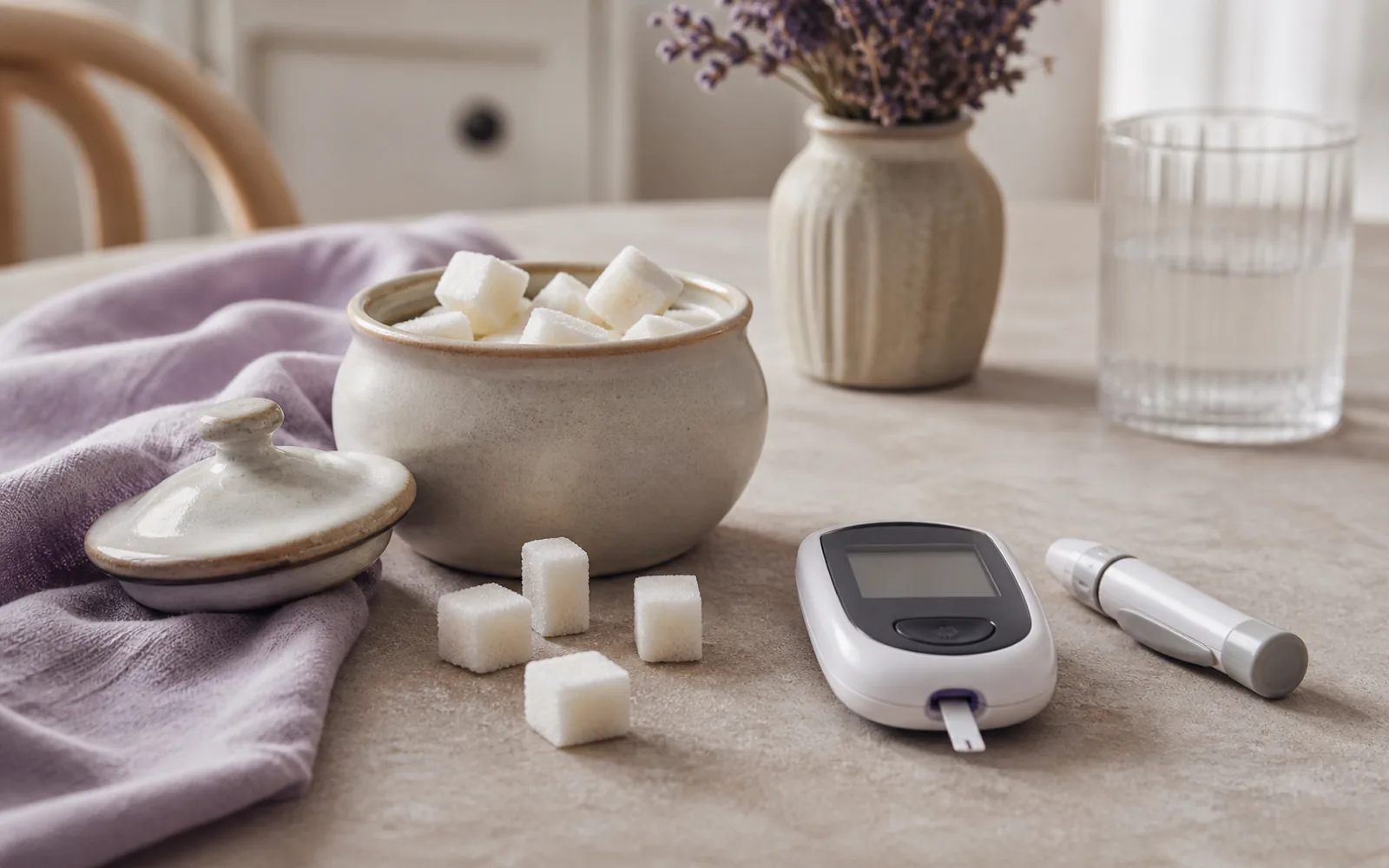
In this article, we will explore how insulin and sugar may affect Hidradenitis Suppurativa (HS).
Alongside the sex hormones I discussed in the previous article on the menstrual cycle, acne inversa may also be influenced by other hormones.
Insulin, in particular, can contribute to significant imbalances in the body.
Understanding the mechanisms behind insulin release can help us approach this topic more thoughtfully. This overview reflects my personal research and experience, not medical advice. I am not a doctor, and HS currently has no definitive cure.
Sugar and insulin
To understand how insulin and sugar may affect Hidradenitis Suppurativa, we first need to understand how sugar acts on us, or more precisely, inside our bodies.
"Sugar can be harmful. Limit your intake."
This is a very common statement. Yet despite all the warnings, few people truly understand how excessive sugar intake can affect the body.
Simple and complex carbohydrates
First, it is important to understand that sugar can come from two nutritional sources:
- simple carbohydrates: fruit, table sugar, honey, and milk, as well as processed products that use sugar as an ingredient, such as yogurt, desserts, snack cakes, cookies, breakfast cereals, jams, fruit juices, and other drinks. Sugar is also used as a thickener, preservative, and flavor enhancer, so it is found almost everywhere. Vegetables contain only small amounts, and their fiber helps moderate digestion.
- complex carbohydrates: whole grains, root vegetables, and legumes.
Our bodies use the food we eat as a source of energy, and sugars play an essential role for both our muscles and our brains. They can be obtained from both sources listed above, although complex carbohydrates take longer to break down.
I mention this because discussions about sugar often focus mainly on simple carbohydrates. I suspect that most people get much of their sugar from this source, which can also be more problematic when consumed in excess.
When insulin is released
Whenever we consume sugar, blood glucose levels rise, prompting the body to increase insulin production.
When this happens repeatedly over time, the body may struggle to manage the process effectively.
The system may become less efficient, increasing the risk of developing insulin resistance, which means the body responds less effectively to insulin.
In more serious cases, this can contribute to the development of diabetes.
Sugar may also affect the skin through a process known as glycation. During glycation, sugars bind to proteins in the body, which can alter their structure and reduce their function.
When this affects collagen and elastin, it may contribute to accelerated skin aging.
On top of this, highly sugary foods can reinforce cravings and habitual consumption.
Some people find that cravings begin to ease after a few weeks of reducing their sugar intake, although there is no universal 21-day timeline.
If you try to reduce it in your diet, you may notice mood changes, cravings, or other reactions.
These reactions may reflect your body adjusting to the change.
Is fructose dangerous?
Products containing fructose, a sugar naturally found in fruit and often added to processed foods, are not necessarily an exception.
Its natural origin does not automatically make concentrated or added fructose harmless. Whole fruit also contains fiber, which, as mentioned above, helps moderate digestion.
When fructose is separated from the whole fruit and added in concentrated forms to processed foods, vitamins, or supplements, it can affect the body differently from fructose consumed in fiber-rich whole fruit.
There is also a condition known as "fructose malabsorption": when cells in the small intestine cannot fully absorb fructose, symptoms such as stomach pain, bloating, or diarrhea may occur.
High fructose intake has also been associated with conditions such as insulin resistance, particularly alongside magnesium deficiency, and high blood pressure.
How excessive sugar intake can affect health
In short, excessive sugar intake can be harmful and is generally best limited, regardless of its source. It may also influence inflammatory processes in the body.
As Sarah Ballantyne discusses in her book "The Paleo Approach: Reverse Autoimmune Disease and Heal Your Body", consuming sugar may increase the production of free radicals.
Because oxidative stress can be associated with higher levels of pro-inflammatory cytokines, excessive sugar intake could potentially affect HS symptoms. Individual responses may vary and may also relate to insulin sensitivity.
So if you notice that your symptoms flare after eating a sugary spread such as Nutella, this may be one possible factor to discuss with a qualified healthcare professional.
To better understand how insulin and sugar may affect Hidradenitis Suppurativa, we now need to look at insulin resistance.
Insulin resistance, a threat to our health
"Insulin resistance, often associated with metabolic syndrome, occurs when the body's cells become less sensitive to the effects of insulin. As a result, a given amount of the hormone produces a smaller biological effect than expected."
That is the scientific definition, but let us look more closely at what it means.
Whenever we consume sugars, the pancreas, which produces insulin, releases this hormone into the bloodstream to help manage glucose.
Our bodies move glucose into the brain, muscles, and other tissues, where it can be used for energy or stored for later.
When sugar intake is consistently high, however, this process can become less efficient. Cells may respond less effectively to insulin, while the pancreas detects that blood glucose remains elevated and continues to release more insulin. Over time, this cycle can contribute to insulin resistance.
What insulin resistance can mean for your health
At this stage, your doctor may diagnose metabolic syndrome and explain that you have an increased risk of developing type 2 diabetes and other conditions.
The journal "Metabolic Syndrome and Related Disorders" discusses metabolic syndrome as a risk factor associated with cardiovascular disease, stroke, cancer, polycystic ovary syndrome, gout, and asthma.
It may also be associated with other health issues, including impaired glucose tolerance, dyslipidemia with high triglycerides, low HDL cholesterol, high blood pressure, and localized inflammatory conditions.
It is not uncommon for people living with Hidradenitis Suppurativa to also have one or more of the conditions mentioned above.
This helps illustrate the clear connection between insulin regulation and other health conditions.
When some people believe they have HS because they are "obese", they may be focusing on one possible manifestation rather than the full picture. Obesity is associated with HS severity in some people, but it is not a simple explanation for why someone develops the condition.
Metabolic syndrome may be one part of that picture, as it is often associated with abdominal fat accumulation and other features commonly linked to obesity.
Insulin and androgens
It is also worth knowing that some studies have found an association between high insulin levels and high androgen levels in women with PCOS.
These hormones also help regulate hair growth and can contribute to acne, which may be relevant for people living with HS.
In short, insulin plays an important role in health. In the situations described above, a qualified healthcare professional may recommend evidence-based strategies to improve insulin sensitivity based on the individual's needs.
Glycemic index, glycemic load, and insulin index
If you want to understand how food may influence insulin release, it can be helpful to pay attention to what you eat. Three indicators are commonly associated with foods:
- Glycemic index (GI): this indicates the rise in blood glucose caused by eating a portion of a food compared with a reference food, usually glucose or white bread, when the carbohydrate content is the same. The glycemic index is expressed as a percentage. A food with a glycemic index of 50% produces a rise in blood glucose equal to half the rise caused by glucose or white bread.
- Glycemic load (GL): GI considers only the quality of carbohydrates, while the glycemic response to a food is also influenced by the quantity consumed. Glycemic load accounts for both factors. GL is calculated by multiplying the glycemic index by the amount of carbohydrates in the food, then dividing by 100.
- Insulin index (II): this measures the body's insulin response after eating a particular food.
These three factors are closely related. Without going into every detail, you can find information online about these values for many foods. In general, the higher the GI and GL, particularly the GL, the greater the associated insulin response may be.
Understanding these indicators may help you identify foods that are less likely to cause large blood glucose and insulin spikes, ideally with guidance from a qualified healthcare professional.
This concludes our high-level overview of how insulin and sugar may affect Hidradenitis Suppurativa.
In the next article, I will explore the connection with stress hormones and how insulin, under certain conditions, may interact with a person's wider hormonal balance.
Reader comments (0)