
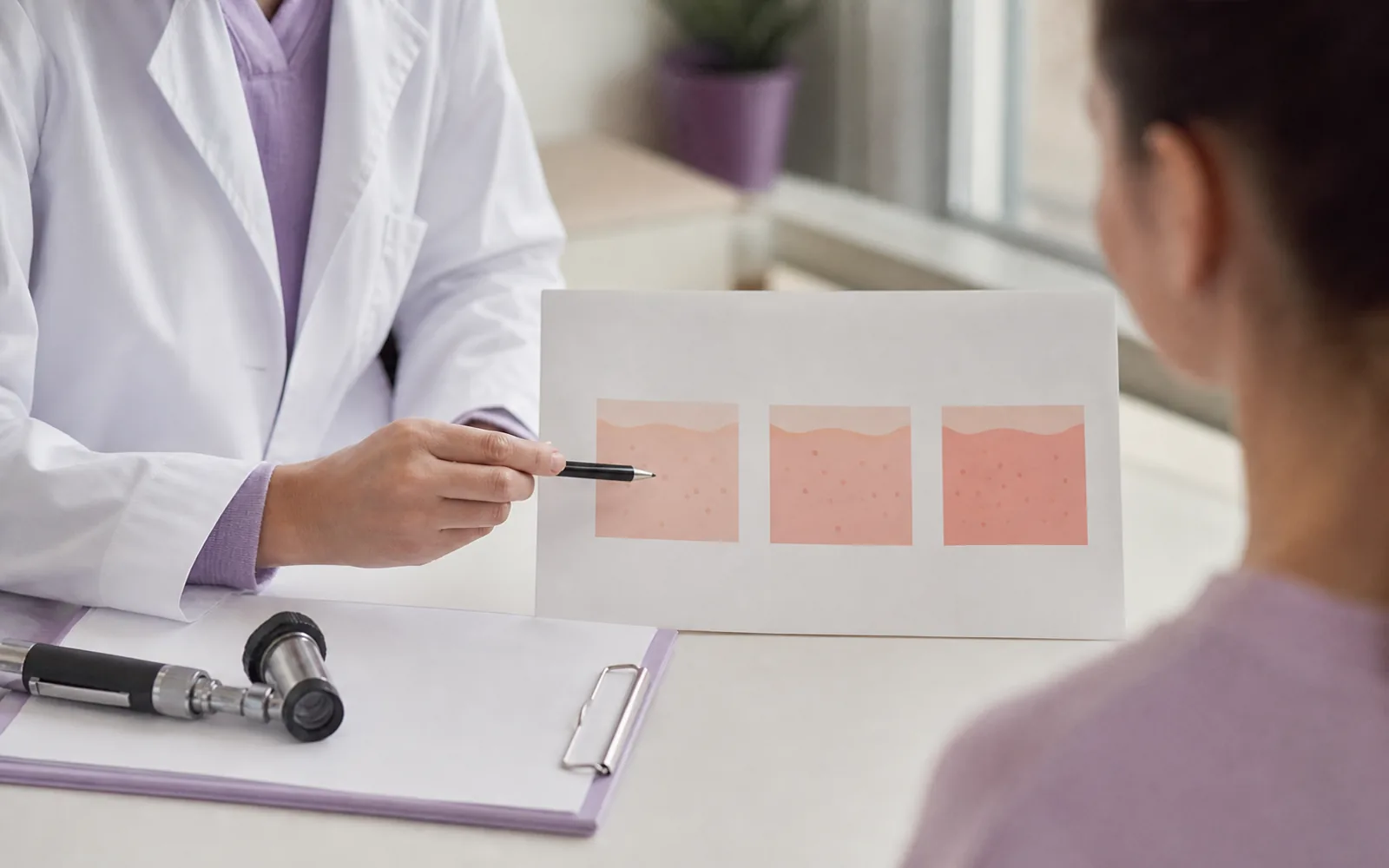
After briefly introducing the symptoms of Hidradenitis Suppurativa (HS) and the Hurley stages in the previous article, here I will explore the topic in more detail and explain the differences between the stages.
IMPORTANT: the images below are for reference only. A medical diagnosis is essential to understand which of the three stages may apply to you. I am not a doctor, and this article provides general information and personal perspective, not medical advice. HS has no definitive cure, and treatment outcomes vary.
As I mentioned in the previous article, acne inversa does not follow a guaranteed pattern of progression. Someone at stage I may worsen, improve, or remain stable. The same applies to the other stages.
Stage I
According to the Hurley staging system, stage I HS is considered milder than the later stages of the condition.
Some people may not even realize they have acne inversa. It can appear as unusual lumps, spots, and painful "boils" that develop from time to time, sometimes only once or twice a year, and may then settle on their own.
There may be one nodule, or there may be two or three. They can remain small for a long time.
Some people think they simply have acne on their buttocks or ingrown hairs in their armpits.
The areas most commonly affected include the groin, buttocks, pubic area, thighs, armpits, and the skin above or beneath the breasts. In men, lesions may also affect the penis and scrotum.
A person with stage I HS may have a flare so mild that it is mistaken for ordinary acne, then later develop a single, extremely painful abscess with marked inflammation, swelling, and eventual drainage.
It is not unusual for people at stage I to also experience acne on the face, neck, or back.
Because it may not initially seem like a major problem, apart from the embarrassment, people with stage I HS may not seek help, receive a diagnosis, or talk to anyone about it.
They may not know what they have, let alone how to manage it.
Some try standard acne treatments with some success, while others find that their flares become more severe over time.
Stage II
In the Hurley staging system, stage II is when the symptoms of Hidradenitis Suppurativa become more noticeable.
Painful lumps become larger and may develop into large abscesses that rupture after an extended period, sometimes weeks. Pus may drain, as it would from a spot, but it may be mixed with blood.
Once they rupture, these "boils" can seem to drain forever.
It may take weeks for them to drain on their own and sometimes months for the lesions to heal.
Many people at stage II have at least two abscesses on their body at the same time, each at a different point in the healing process.
Some people are fortunate enough to have a month or two of recovery between one lesion and the next.
Some people see a doctor to have an abscess drained, only to find that the lesion does not always heal completely. It is also fairly common for a new "boil" to appear in the same place before the previous one has fully healed.
Hard, deep, and extremely painful lumps are also common at stage II. These lumps can be particularly frustrating because they remain beneath the surface of the skin, making them difficult to resolve.
Scarring also becomes more noticeable at stage II.
Clusters of abscesses and spots may appear and take several months to settle completely, while others come and go in different areas of the body.
Abscesses can form extensive tunnels beneath the skin and leave scarring throughout the affected area.
Doctors may suggest incision and drainage for short-term relief at this stage, although the right approach depends on the individual. Open or draining lesions can become infected, so it is important to seek medical advice if you notice signs of infection.
As stage II becomes more severe, you may feel deeply frustrated and limited at work and in social situations. In some cases, movement may also become difficult.
Stage III
At stage III in the Hurley staging system, abscesses can grow as large as a golf ball and, in rare cases, even as large as a baseball.
Lesions often join together, grow larger, and form raised clusters.
The pain at stage III can be overwhelming and may significantly limit daily functioning.
At this stage, HS can affect every part of your life, restrict your movement, and affect your mood. It is no longer simply a source of embarrassment, but a condition that can be genuinely disabling.
At this stage, intense inflammation can involve broad areas around the hair follicles and nearby skin structures.
Some people at stage III may also experience headaches, cramps, joint pain, or depression. These symptoms can have many causes and should be discussed with a healthcare professional.
People at stage III are generally more likely to consider surgery.
They may have already tried several options recommended by their doctors without enough relief and may then consider medications or procedures, each with benefits and risks to discuss with their care team.
In some cases, recovery after surgery, although invasive, may be less painful and faster than waiting for lesions to drain on their own.
Lesions at stage III may take longer to heal than they would at an earlier stage, but improvement and recovery from individual lesions are possible.
Never lose hope.
Reader comments (0)